

A service agreement is a contract between a property owner or manager and an external supplier to perform regular service, inspection or maintenance on a technical system or installation in the building. This may involve ventilation systems, lifts, sprinkler systems, fire alarm systems, cooling units, heat pumps, electrical systems or other critical systems.
The agreement regulates what is to be done, how often it is to be done and what the supplier must document afterwards. The associated service report is proof that the work has been carried out and that any findings have been recorded.
For a typical commercial building with multiple technical installations, it is not unusual to have ten to twenty active service agreements. For a portfolio with multiple buildings, we are quickly talking about hundreds of reports per year that need to be received, read, archived and followed up.

In most property organisations, following up on service agreements is a task that belongs to one or a few people. It is the technical property manager who knows which agreements exist, which reports are due and what needs to be followed up. The system works as long as that person is present, engaged and has capacity.
But what happens when that person is on holiday, on sick leave or leaves?
The history and overview disappears. And nobody knows any longer whether the supplier has actually delivered what they are supposed to. What should have been a systemic responsibility is in reality a personal responsibility, and that is a vulnerability most people are not aware of until it is too late.
The problem is amplified in organisations with large portfolios where responsibility for service agreements is distributed across multiple managers. Without a shared system, it is almost impossible to get an overall picture of which agreements are active, which reports have been received and which deviations are open across the buildings.
Even when service reports are actually delivered, it is not certain that they are processed. The report lands in an inbox, perhaps forwarded to a folder, perhaps not. The deviations that the supplier described on page five are not necessarily read, and they are definitely not automatically created as tasks in the system.
The result is that deviations continue to exist in the shadows. Technical problems that were flagged six months ago are still unaddressed, not because someone chose to ignore them, but because the process was not set up to catch them.
A service report from a ventilation installer may, for example, contain a note that a filter is overdue for replacement, that air volumes are outside specification or that a component is showing signs of wear. None of these notes automatically triggers a task, an order or a notification. It requires someone to read the report, understand the content and act on it. In a busy day-to-day, that does not always happen.
This is not a problem exclusive to small organisations with limited resources. It is a structural challenge that affects the industry across size and ambition levels.
As Steinar Seim, co-founder of Propely, puts it:
«After conversations with several of our customers, it became clear that managing service agreements and reports was a manual, time-consuming and repetitive process. That was when we realised that this kind of work would be perfect to structure for a machine.»
Missing documentation and undocumented services are not just an operational problem. It is a direct risk to the building's value.
During technical due diligence, service documentation is reviewed systematically. The buyer will want to know whether the agreements are in place, whether the reports have been received and whether the deviations have been closed. Shortcomings related to maintenance and service are among the factors that most often affect the purchase price in a property transaction.
The same applies during inspections from the fire service, electrical inspection authorities and other public control bodies. They expect you to be able to document that mandatory service has been carried out and that deviations have been recorded and followed up. If you cannot, it is your organisation that bears the responsibility and the potential consequences, regardless of what is set out in the agreement with the supplier.
For insurance companies, the picture is the same. If damage occurs and it turns out that the service on the relevant system has not been documented, it can have direct consequences for the insurance settlement.
The problem is not the suppliers, it is the system that is not set up to catch the shortcomings.
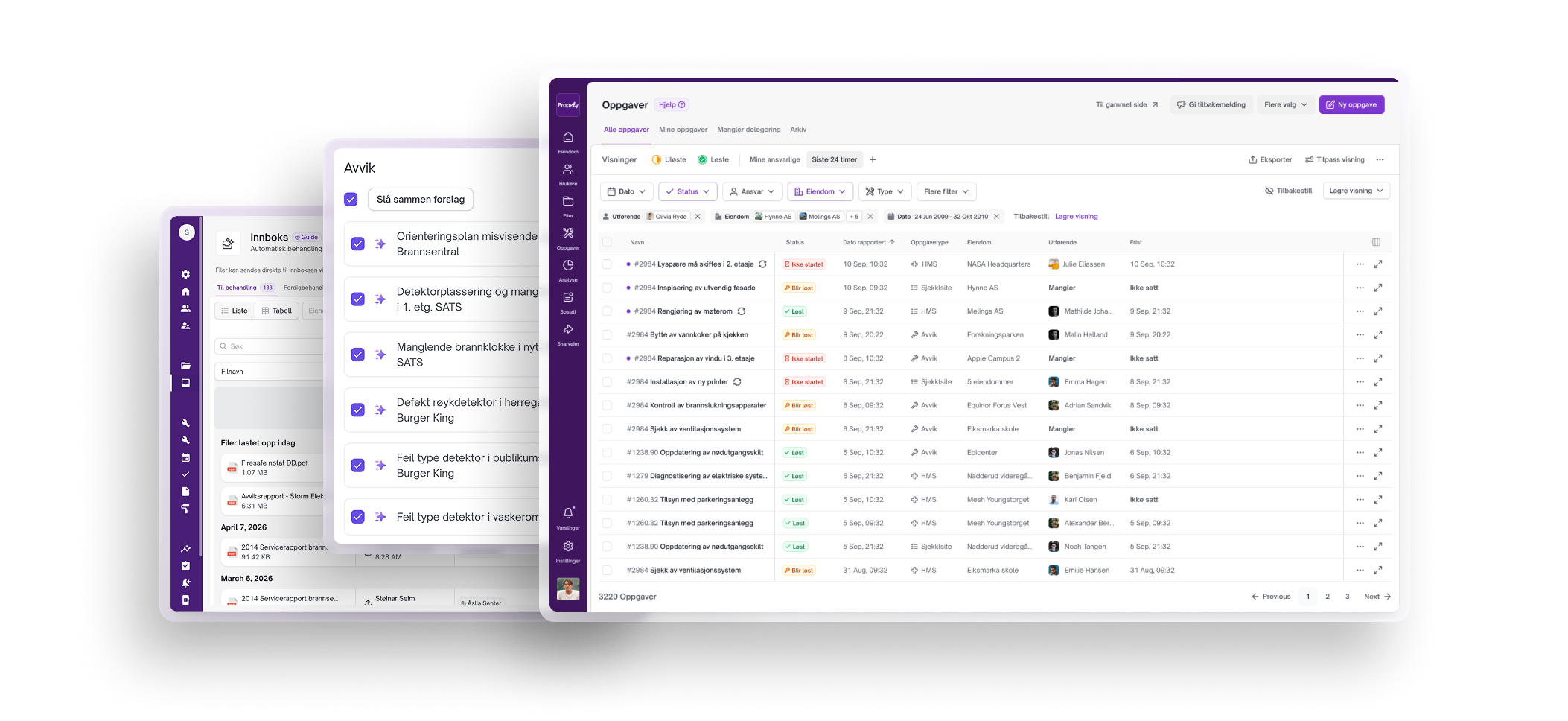
Propely has built a dedicated AI inbox that handles the entire process from receipt to follow-up of service reports and service agreements.
All service reports are sent to one dedicated email address. You avoid losing documents in personal inboxes or searching across systems. Everything is gathered and linked to the correct property and service agreement.
When the report arrives, artificial intelligence reads through the content and extracts key information. Supplier, person in charge, date and important findings are automatically identified and structured in the FM system without manual processing. Propely is built to work seamlessly with the suppliers you already use. Reports are received directly via email regardless of format, and the supplier does not need to change their way of working.
Deviations are identified directly in the reports and further measures are suggested so that you can easily make a decision and approve. The deviations are assigned to the correct person responsible so that follow-up happens quickly and does not remain unprocessed.
You maintain full control over what suppliers actually deliver. The system shows which service reports have been received and which are missing, so you can follow up in good time before it creates problems. All documentation is stored in a structured manner in accordance with NS3451 and NS3456, so that the properties are always up to date and ready for review.
As Christer Trældal, property manager and project manager at Eco Forvaltning, describes it:
«We see great value in Propely's AI tools, which give us better handling of incoming service reports and deviations from external parties. It also makes it easier to delegate deviations directly to our service partners, so that the right measures are initiated quickly and in a targeted manner.»

The biggest benefit of structuring the follow-up of service agreements is not just about avoiding problems. It is about changing the way you manage the building.
When you have a complete overview of which service agreements are active, which reports have been received and which deviations are open, you can plan maintenance ahead of time. You can identify patterns, such as a particular system repeatedly having notes about the same type of problem, and act on it before it develops into a larger fault.
You go from reacting to problems after they have occurred to preventing them. It is more cost-effective, it results in fewer acute situations and it gives you better control over the building's technical condition over time.
Without structure and control, the risk of insufficient follow-up and deviations increases. With Propely, you get updated, traceable and accessible documentation that provides a better basis for decisions and reduces risk, so that you spend your time on what actually requires your judgement.
Read more about service agreements and service reports here.
Want to see how Propely handles service agreements and reports in practice?
Book a demo and get a walkthrough tailored to your portfolio.